


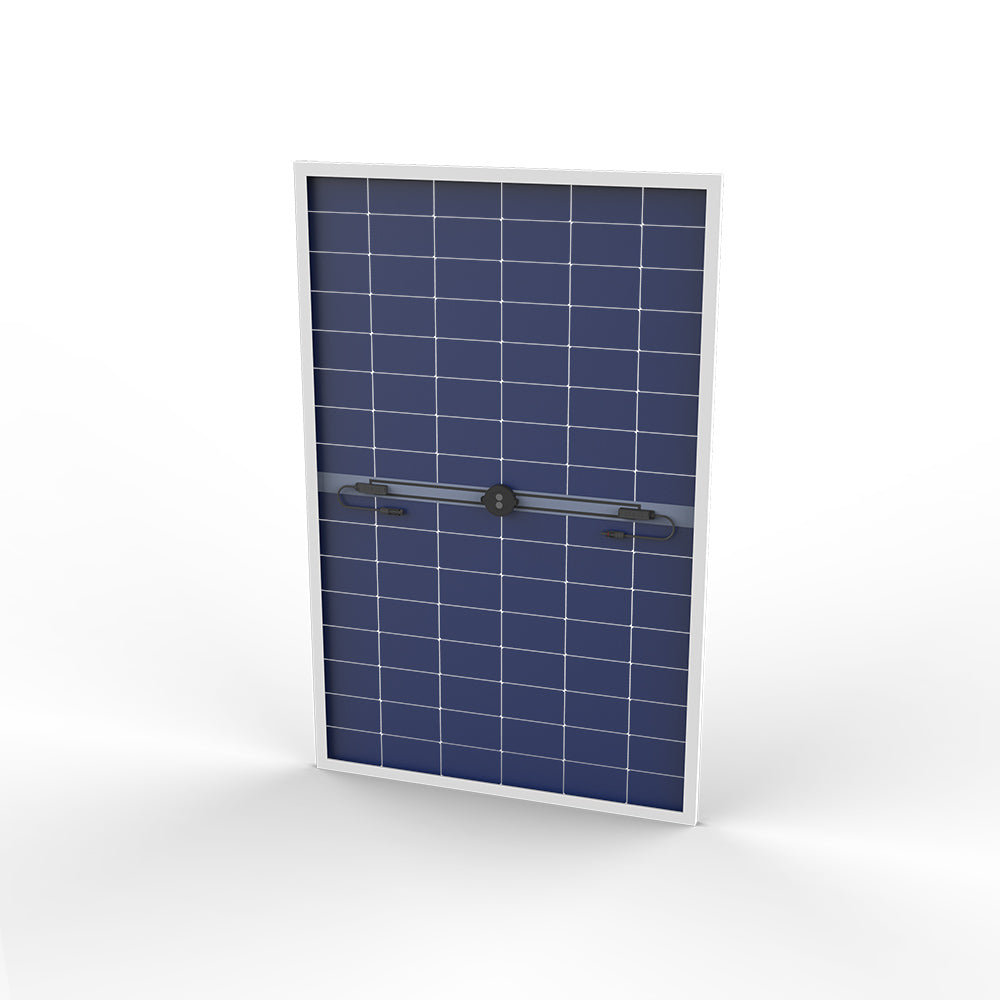
Product Description
Advantages

Installation Diagram of Intelligent PV Modules![]()
![]()
![]()

Mechanical Characteristics Unchanged![]()
|
Dimensions |
1762 x 1134 x 30 mm |
|
Weight |
About 24.9 kg |
|
Solar Cell |
TOPCon 182 x 105mm (48pcs) |
|
Front/Back Glass |
2.0 + 2.0 mm (0.079 + 0.079 inches) semi-tempered glass |
|
Frame |
Anodized aluminum alloy frame |
|
Junction Box |
IP68(3 bypass diodes) |
|
Output Cables |
4.0/6.0mm²/250mm(+)/350mm(-)/customized length |
Electrical Characteristics Unchanged
|
Electrical Characteristics(STC) |
|||||
|
Maximum Power (Pmax/W) |
460 |
455 |
450 |
445 |
440 |
|
Optimum Operating Voltage (Vmp/V) |
30.38 |
30.21 |
30.04 |
29.86 |
29.68 |
|
Optimum Operating Current (Imp/A) |
15.14 |
15.06 |
14.98 |
14.90 |
14.82 |
|
Open Circuit Voltage (Voc/V) |
35.77 |
35.57 |
35.37 |
35.17 |
34.97 |
|
Short Circuit Current (Isc/A) |
16.08 |
16.00 |
15.92 |
15.84 |
15.76 |
|
Module Efficiency (%) |
23.0 |
22.8 |
22.5 |
22.3 |
22.0 |
Application scenarios
|
|
|
|
 Residential Rooftop
 Commercial and industrial rooftop
 Special scenario
Most Frequently Asked Questions by Customers & Our Answers
1.What exactly does this module offer beyond a conventional module?
From a power-generation perspective, it performs exactly the same as a conventional module. The difference is that it adds a real-time monitoring capability for the module’s own operating condition, including voltage and temperature, helping detect abnormal risks at an early stage.
"It is not designed to generate more power — it is designed to give you greater peace of mind."
2.Will it affect the module's power output or reliability?
No. The monitoring system is designed as a fully bypassed architecture and is electrically isolated from the module's main current path, cell strings, and diodes. It does not participate in power generation, does not shunt current, and serves only for condition sensing.
"The way the module generates power remains completely unchanged."
3.With added electronics, will it be more likely to fail?
No. Instead, this solution is designed from a risk-control perspective. Electronic monitoring systems have extremely low power consumption and a simple structure, but they can detect abnormalities in temperature, voltage, and other parameters in advance, preventing small problems from escalating into major incidents.
"It is not a source of risk, but a risk warning device."
4.If the monitoring system fails, will it affect module operation?
No. Even if the monitoring system fails, the module can still generate electricity normally like a conventional module. There is no situation where "it cannot be used when the monitoring system fails".
"In the worst case, you lose a pair of eyes — not the ability to generate power."
5.Will the installation become more complicated? Will additional wiring be required?
No. The component size, wiring method, and installation process are the same as those of conventional components, which does not increase the construction difficulty of EPC or change the original system structure.
"Installation is the same as with a standard module."
6.What is this data used for? What direct benefit does it bring?
These data are mainly used to: detect abnormal temperature rises and voltage anomalies, and Provide evidence for O&M decision-making and responsibility assessment. For owners, the core benefits are fewer incidents, less disputes, and greater peace of mind.
"You don't need to monitor the data every day, but it can help you clarify the issues when needed."
7.Is this an Internet of Things product? Could there be any network security issues?
Our design concept is: safety first, and avoid unnecessary connectivity. Whether communication is enabled, and how it is implemented, can be configured according to project requirements. It is neither mandatory nor dependent on the public internet, and it does not affect the safety of the module itself.
"It does not need to be connected to the cloud to create value."
8.Will it increase long-term O&M costs?
No. On the contrary, it helps reduce unpredictable O&M costs because:
1.Abnormalities can be identified earlier 2. Unexpected downtime can be reduced 3. Incident-handling costs can be lowered
"A small increase in upfront cost can deliver more than a decade of peace of mind."
9.With more electronic systems, won't they break more easily?
It is true that this is not the cheapest module. However, it is specifically designed for rooftops, urban environments, and commercial & industrial applications. In these scenarios, the loss caused by one single incident is often far greater than the price difference between modules.
"Rooftop PV isn't about buying the cheapest one— it's about buying the one you are least likely to regret."
10.Is this module suitable for my project? Are there projects where it is not recommended?
If the project is a large-scale ground-mounted power plant focused only on the lowest LCOE, then a conventional module is usually sufficient. However, if the project involves residential rooftops, commercial & industrial rooftops, urban buildings, or applications where safety, stability, and accountability matter, then this type of module is a better fit.
"Not every project needs it — but in the right application, its value is significant."